Investor Engagements



Engagement Overview
What are investor engagements?
Engagement refers to the process undertaken by an institutional investor, or a group of institutional investors, to engage in a dialogue to discuss material risks and opportunities with companies with the aim of achieving long term business resilience and sustainable value for investor portfolios.
Investors may enter into an engagement for the following reasons:
Individual investors may have limited access to companies due to the size of their holdings.
The greater the aggregate support for an issue – in number of investors and AUM – the stronger the signal it sends to both target companies and the wider market.
Knowledge building. Investors may not have the technical knowledge to launch their own engagement and want to learn from experts or other investors.
FAIRR facilitates engagements on behalf of its investor members, supporting investor stewardship or engagement teams who typically have limited capacity to engage many companies in their portfolio. The FAIRR team coordinates the process and provides administrative support.

How do engagements work?
FAIRR facilitates investor engagements for our members. FAIRR’s investor engagements provide the opportunity for dialogue around topics which contribute to long term business resilience and sustainable value of investee companies.
FAIRR’s engagements are underpinned by assessment frameworks which are informed by leading academics, industry experts, investors and corporates and those are used to measure and report on company progress.
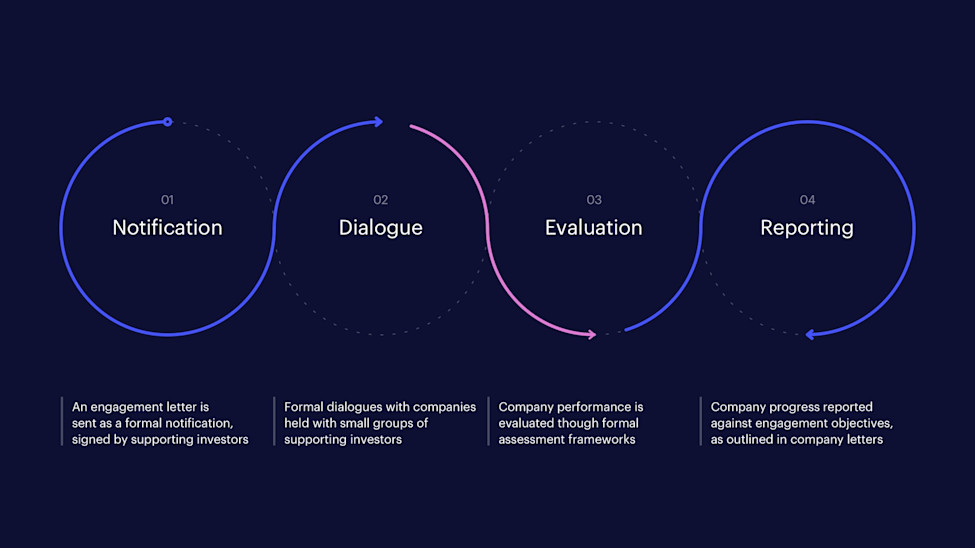
The engagement process is structured around 4 fundamental actions:
Formal notification of companies via an engagement letter signed by supporting investors;
Formal dialogue with companies in meetings held with small group of investor representing the broader coalition;
Measuring company progress based on primary (company response to letter and meetings) and secondary (public disclosure including company websites, media, reports) data;
Reporting on progress against the engagement objective.
Latest Activity
Report Launch: Restaurant Antibiotics Engagement Phase 2 Progress Report
Explore key findings from Phase 2 of FAIRR’s Restaurant Antibiotics Engagement, which aimed to encourage 12 of the largest North American Quick-Service Restaurants to implement global antibiotic policies that address AMR risks across six animal protein supply chains.
Report Launch: Protein Diversification Engagement Phase 2 Progress Report
Explore key outcomes from the second year of FAIRR´s engagement, which assesses how 12 of the food retailers and 8 brand manufacturers are using protein diversification as a tool to mitigate climate, nature and health risks and build business resilience.
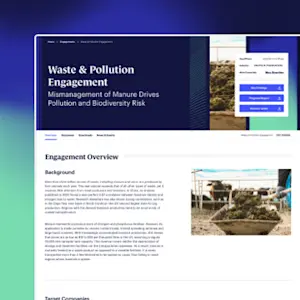
Report Launch: Waste and Pollution Engagement Phase 3 Progress Report
The Waste and Pollution Engagement Phase 3 Progress Report highlights the key outcomes from the final phase of this engagement, focused on how 10 meat producers and two agrochemical companies can reduce their exposure to and impacts on water quality risks from animal waste and fertiliser use.
Report Launch: Sustainable Aquaculture Phase 3 Progress Report
The Sustainable Aquaculture Phase 3 Progress Report highlights the key outcomes from the final phase of this engagement, focused on how seven major salmon producers can reduce their dependence on wild-caught fish in salmon feed and de-risk their operations.
Current Engagements
Animal Pharmaceuticals Engagement
This engagement tackles the lack of transparency from animal pharmaceutical companies over how they manufacture, market, and sell antibiotics – practices that could contribute to AMR hotspots in the environment and drive high levels of antibiotic use.
Follow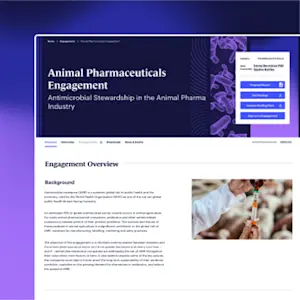
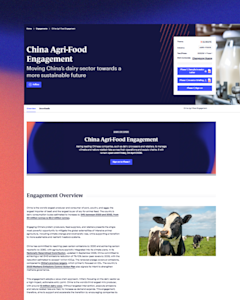
Protein Diversification Engagement
This engagement assesses 20 global food retailers and manufacturers to integrate protein diversification into climate transition plans.
Follow
Restaurant Antibiotics Engagement
This engagement addresses the quick-service restaurant sector on the need to improve antibiotic stewardship practices.
Follow
Seafood Traceability Engagement
Full-chain traceability is key to addressing ESG risks and unlocking opportunities in global seafood supply chains
Follow
Previous Engagements
Antibiotics Stewardship Engagement
Overuse of Antibiotics in Protein Supply Chains

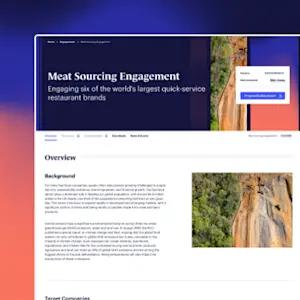
Meat Sourcing Engagement
Engaging six of the world’s biggest quick-service restaurant brands
Sustainable Aquaculture Engagement
Climate and Biodiversity Risk in the Farmed Salmon Industry

Sustainable Proteins Engagement
Assessing 23 global food retailers and manufacturers to build climate-aligned protein portfolios

Working Conditions Engagement
Unpacking Labour Risk in Global Meat Supply Chains

Signatory Terms of Reference
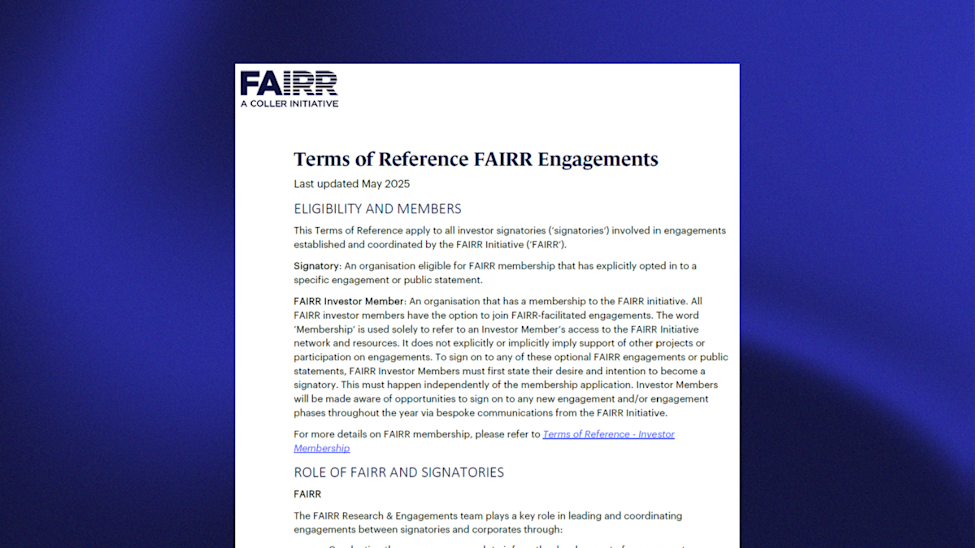
Our Investor Engagement Terms of Reference applies to all investor signatories involved in our engagements established and coordinated by the FAIRR Initiative (‘FAIRR’). All FAIRR members can join FAIRR-coordinated collaborative engagements. View our Terms of Reference for FAIRR Investor Engagements below.