Methodology overview
The Water Risk Monitor (WRM) model quantifies the annual financial cost of water stress for 18 major publicly listed livestock companies, representing US$354 billion in combined FY2024 revenue and 20% of the global livestock market. It covers grain and feed production, animal raising, and animal processing and packaging.
Research and modelling
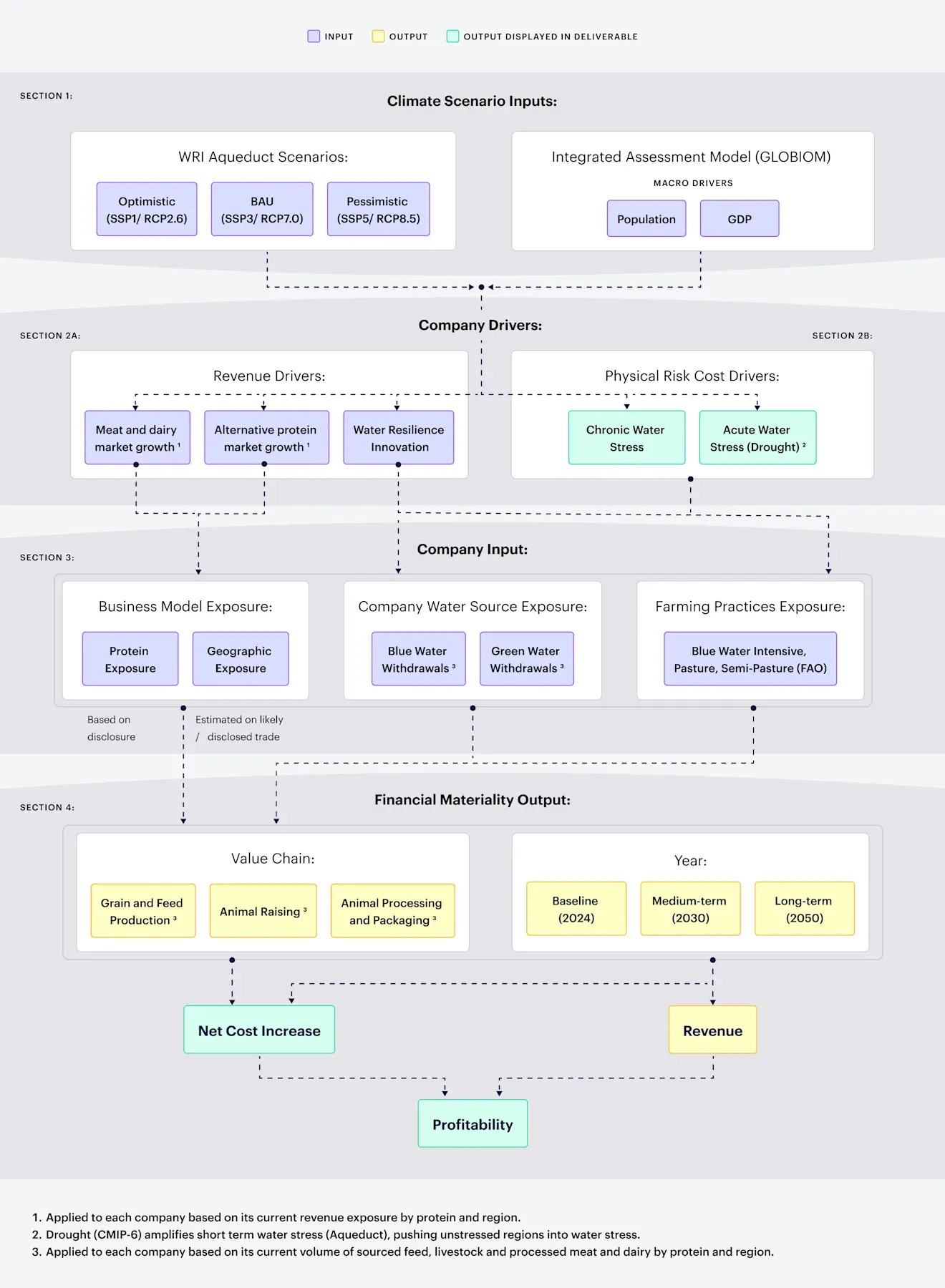
The WRM model follows a three-step process. It assesses each company's water footprint across the value chain, evaluates how much of this water is sourced from high water stress regions, and quantifies the annual cost impact on the company profitability under three climate and socioeconomic scenarios from 2024 to 2050.
Step 1: Assesses company water footprints
Step 2: Assesses exposure to water stress
Step 3: Estimates financial materiality of risk
The climate scenarios, physical and revenue drivers, company inputs and impacts (financial materiality outputs) are illustrated below.
Information collection
The Water Risk Monitor model draws on the following datasets:
In collaboration
The Water Risk Monitor model was developed by the FAIRR Initiative in partnership with Bluerisk.
An expert Technical Working Group, comprising representatives from the World Resources Institute, The Nature Conservancy, the International Institute for Applied Systems Analysis, and South Pole, provided technical guidance on the model's development, drawing on their expertise in water risk data, climate scenario analysis, and land-use modelling.
Want to know more?
To understand the terms used in the WRM model and report, visit the Glossary page.
For more information on how the model has been developed and the underlying data supporting it, download the Water Risk Monitor Model Methodology and data set.