Overview
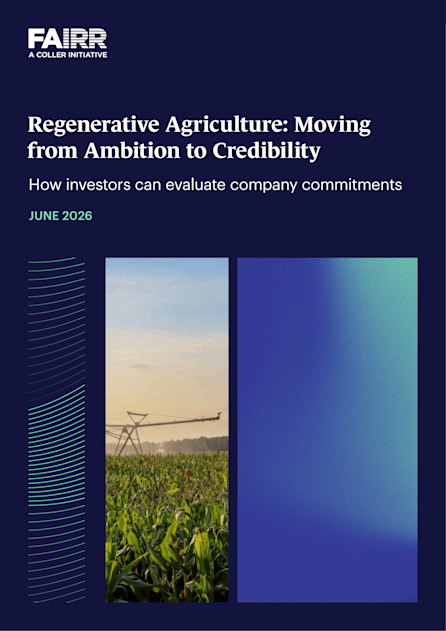
When FAIRR published its research on corporate regenerative agriculture commitments in 2023, enthusiasm for the concept was widespread. Companies in the agri-food sector have embraced regenerative agriculture to meet climate and nature targets, build supply chain resilience, especially in the context of heightened geopolitical instability and price volatility, and drive long‑term profitability.
However, ambition alone is insufficient. If regenerative agriculture is to support such outcomes, its credibility, delivery, and limits must be discussed transparently by companies and investors. Companies’ regenerative agriculture programmes reveal several trade-offs, gaps and contradictions that need to be addressed. These challenges are particularly evident in areas such as insufficient financial investment, limited support and incentives for farmers, and the continued reliance on pesticides and other chemical inputs that may offset other benefits from regenerative agriculture.
This report builds on FAIRR’s earlier work, focusing on how corporate regenerative agriculture approaches have evolved among the 78 companies assessed, and whether programmes are becoming more robust, measurable, and credible over time. It also evaluates whether companies are moving beyond high‑level commitments toward concrete actions and outcomes.
The findings of this report can help investors to:
Broaden their understanding of corporate commitments;
Support their stewardship activities associated with regenerative agriculture; and
Gain company-specific insights.
Report Highlights
64% of companies mention regenerative agriculture in their disclosures, up from 63% in 2023.
96% of companies that mention regenerative agriculture have identified climate as a financial risk, while 68% have done so with water.
28% of companies have quantified targets for regenerative agriculture overall, down from 35% in 2023.
52% of companies make a quantitative or qualitative link between regenerative agriculture and their scope 3 emissions targets, compared to 24% in 2023.
No company has set a target to reduce the use of pesticides as part of their regenerative agriculture programmes.
40% of companies support farmers financially to adopt regenerative agriculture, yet spending remains low relative to revenue (0.01% - 0.05%).
54% of companies mention measuring outcomes or having measurement, reporting and verification systems in place, up from 16% in 2023.
10% of companies aim to roll out regenerative agriculture to pork and poultry, compared to 70% for vegetables, fruits and other crops.
Downloads
Main Report
Detailed analysis of trends, company progress and limitations of regenerative agriculture
Examples of leading practice
Company database and engagement questions
Full dataset for 78 companies
FAIRR´s guidance for engagement on regenerative agriculture