Overview
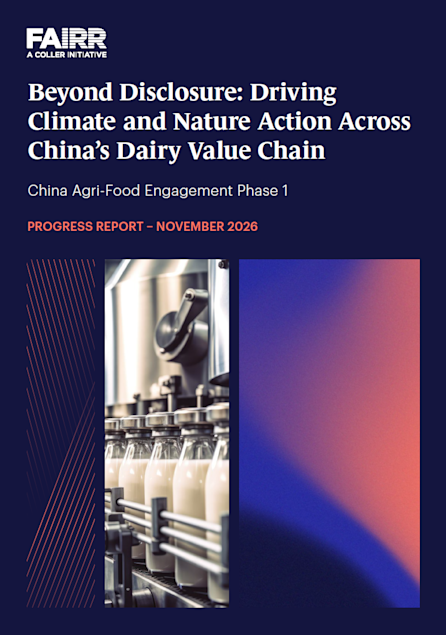
China's dairy sector is undergoing rapid transformation as the country seeks to strengthen food security and improve self-sufficiency. While industrialisation has enhanced production capacity, the sector continues to face growing climate and nature-related challenges, from agricultural GHG emissions, particularly methane, to soy-linked deforestation and land conversion. For investors, understanding how companies manage these risks is increasingly important in one of the world's largest and most strategically important food markets.
This report presents findings from Phase 1 of FAIRR's China Agri-Food Engagement, supported by 36 investors representing US$22.2 trillion in combined assets under management. Delivered in collaboration with Rainforest Foundation Norway and funded by the Jeremy Coller Foundation, the engagement focuses on three leading Chinese dairy processors and one major restaurant chain, examining how companies identify, manage and disclose climate and nature-related risks across their operations and supply chains.
The findings of this report can help investors to:
identify gaps in corporate climate and nature risk management, including how risk assessments inform business strategy, procurement and capital allocation;
engage companies on GHG emissions reduction and disclosure, particularly agricultural methane, forest, land and agriculture emissions, supplier-level data and progress against targets;
assess deforestation-related supply chain risks, focusing on soy sourcing, traceability, supplier engagement and evidence of progress towards deforestation- and conversion-free supply chains; and
inform future engagement priorities, including how companies can move beyond commitments and risk identification towards measurable implementation and transparent reporting.
Key highlights
Key findings from this briefing:
Climate and nature risks are becoming increasingly material to Chinese dairy companies, particularly in relation to feed sourcing, resource efficiency and long-term supply chain resilience.
Sustainability commitments are developing, but disclosure on implementation and outcomes remains limited, making it difficult for investors to assess progress and effectiveness.
Companies' approaches to supply chain traceability differ significantly, reflecting varying levels of operational control and influence across the dairy value chain.
Feed innovation is gaining momentum, with companies exploring efficiency improvements, alternative ingredients and strategies to reduce reliance on imported feed commodities.
Written by

Senior Analyst, Climate & Nature

Junior Analyst