Overview
AMR continues to pose a significant threat to global health and economic security. One in six infections are now resistant to antibiotics and 10% of global equity markets are estimated to be exposed to AMR risk. Furthermore, 73% of all antibiotics sold globally are used in animal agriculture.
Reducing AMR risk will require an end to the misuse and overuse of antimicrobials, taking a One Health approach – considering the interconnectedness of humans, animals and the wider ecosystem.
As major purchasers of animal protein, quick-service restaurants (QSRs) are well-positioned to encourage improvements in antimicrobial stewardship at the farm level, in alignment with WHO Guidelines.
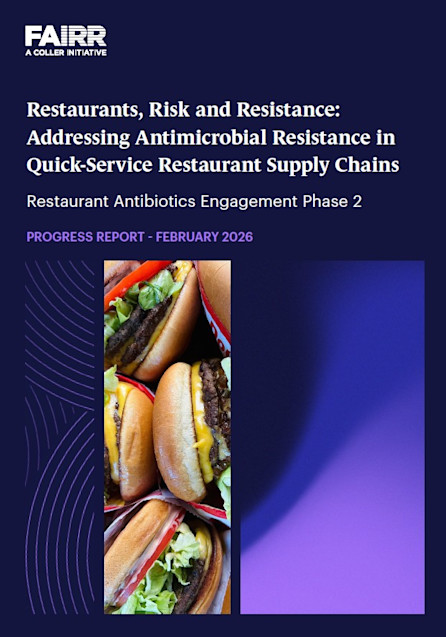
This report presents the insights from Phase 2 (2025/26) of the FAIRR Restaurant Antibiotics engagement and assesses the extent to which 12 of the largest North American Quick Service Restaurants have made progress in implementing policies to address AMR risk across their global animal protein supply chains.
This engagement was supported by 43 investors representing US$8.9 trillion in combined assets.
The findings from this report can help investors understand:
the financial risks AMR could create for companies operating in the animal protein value chain and the business case for engaging on AMR;
company ambition levels and progress towards implementing antibiotic policies that address AMR across six animal proteins;
areas where disclosure still needs to improve.
Key highlights
Key findings from this report:
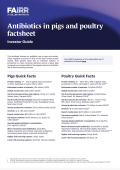
While 10 companies have a policy for broiler chickens, 50% of the QSRs do not have a public policy covering any of the other proteins.
Policy coverage is difficult for investors to understand, as companies do not consistently disclose which countries or franchises are included.
Based on FAIRR’s estimates, the broiler chicken policy coverage varies from 25% - 97% of each company’s global restaurant footprint.
No company currently discloses antibiotic use data, making it unclear the extent to which QSRs are tracking the quantities of antibiotics used in their supply chains.
The number of companies using the US Department of Agriculture’s auditing and certification services to monitor antibiotic use in broiler supply chains has increased.
No company appears to use third-party audits to track antibiotic use in any other protein.
No new time-bound targets have been introduced since Phase 1 of the engagement.
Written by

Senior Analyst, AMR