Aquatic animal welfare is no longer simply an ethical concern. With more than 35 million salmon deaths on Scottish farms in less than three years, and Scottish regulators now being compelled to disclose inspection reports, poor welfare can evolve into material operational, reputational and regulatory risks for seafood companies.
Poor welfare can lead to high mortality rates, disease or parasitic outbreaks, higher reliance on abrasive chemicals or treatments, reduced product quality, and increased costs. As a result, it is important that investors view aquatic animal welfare as an indicator of operational resilience.
The latest findings from the Coller FAIRR Seafood Index, which ranks the sustainability performance of 20 of the world's largest listed seafood companies, suggest that while awareness of welfare issues is growing, much of the industry still has considerable room for improvement, as this Insight explores.
The welfare criteria included in the index was developed with the support from Aquatic Life Institute (ALI), a non-profit organisation focused on advancing the recognition, protection, and prioritisation of aquatic animal welfare within global food systems, grounded in the latest scientific evidence and data.
Strong commitments, but limited evidence of outcomes
Figure 1: All companies’ scores on the animal welfare topic

Source: Coller FAIRR Seafood Index (2026)
Mowi achieves the highest score (63/100) on animal welfare, reflecting the breadth of its publicly disclosed governance framework. The company reports welfare policies, monitoring processes, governance structures and implementation measures across its farming operations.
Likewise, Bakkafrost (55/100) and SalMar (51/100) disclose detailed fish health policies, staff training programmes, facility inspections and welfare monitoring systems.
Salmones Camanchaca (48/100) publishes operational welfare procedures covering key parameters, such as stocking density, oxygen levels, temperature, handling and protocols regarding fasting the fish prior to harvest.
However, strong disclosure should not necessarily be interpreted as evidence that welfare risks have been addressed in practice.
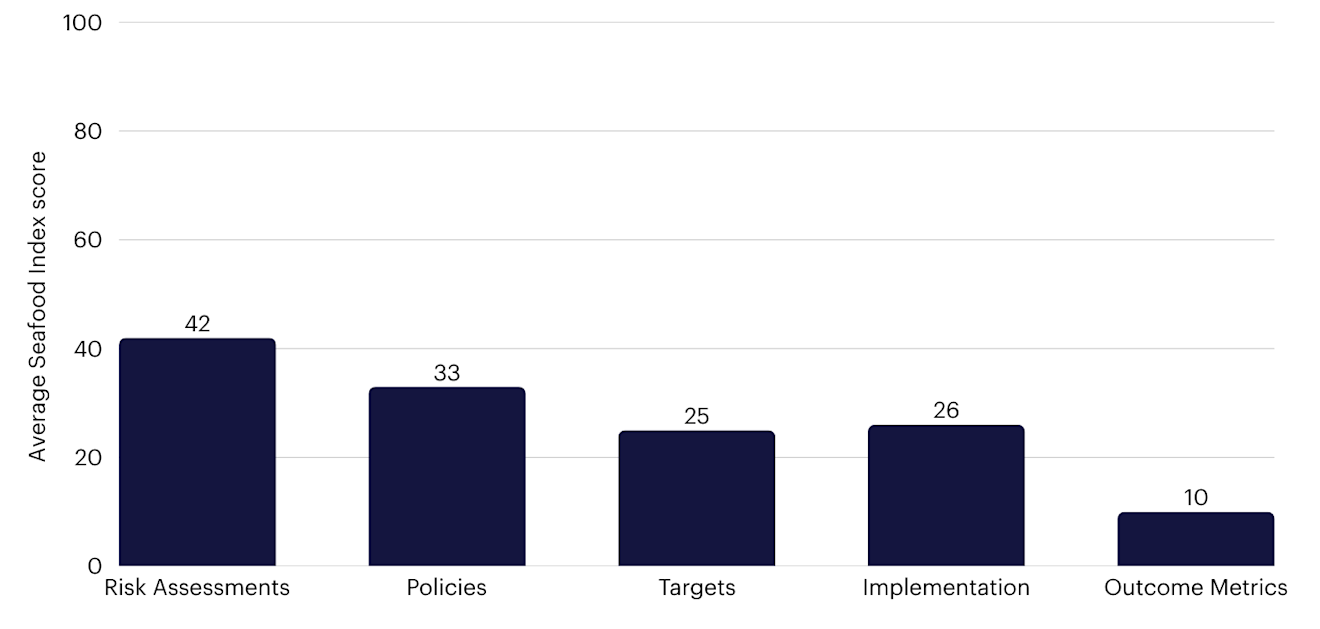
In fact, companies achieved an average score of just 26 out of 100 for animal welfare, making it one of the lowest-performing topics in the Seafood Index.
One clear trend emerges from the results: companies are better at describing how they manage animal welfare than demonstrating whether these measures improve welfare outcomes.
The Coller FAIRR Seafood Index assesses publicly disclosed governance and reporting, rather than independently verifying on-farm welfare performance. This distinction highlights the importance of companies reporting clearly on outcome metrics.
Drilling deeper, Figure 2 shows how all 20 companies perform on average across different Maturity Indicators on animal welfare. It shows that while companies receive higher scores for their policies and risk assessments, implementation and outcomes are lacking.
Figure 2: How companies perform across different animal welfare indicators
But even among the four highest-scoring companies, important gaps remain. None report live transport mortality or stun-to-kill effectiveness, while disclosure on cleaner fish welfare is minimal. Although all companies disclose sea lice counts, none demonstrate a consistent three-year decline in lice levels.
Mortality data also illustrates continuing welfare challenges. In 2023, one million fish died at a Mowi-operated farm in Scotland, with the company attributing the losses to warming waters – a risk expected to increase with this year’s super El Nino and as climate change intensifies.
Diseases accounted for 44% of reported mortalities by Mowi in 2025. Salmones Camanchaca reported seawater mortality increasing by 35% in Atlantic salmon and 79% in Coho salmon in 2025. It is also the only company to disclose the proportion of fish culled for welfare or health reasons.
More oversight of fish farms needed
Between 2021 and 2025, only two welfare inspections of fish farms took place in England and Wales. In Scotland, just 19 inspections were conducted over the same period, despite a sharp rise in welfare complaints to the regulator.
In Scotland, the Rural Affairs and Islands Committee has called for stronger regulation, greater oversight of salmon farms and improved transparency, expressing concern that its recommendations to address high farmed fish mortality had not been accepted by the Scottish Government.
Recent investigations have also raised questions about the reliability of company disclosures. For example, animal welfare NGO Animal Equality found that Bakkafrost misreported a farm as fallow – an important biosecurity measure to kill off any sea lice or parasites before new fish are introduced – and understated the number of fish left on site.
This underlines why transparent welfare metrics are financially material. Without data on mortality, sea lice or antibiotic use, investors may miss early signs of disease, production losses and regulatory risk that can increase costs, weaken profitability and ultimately erode investor returns.
Figure 3: Top four companies’ scores: from policies to outcomes

Source: Coller FAIRR Seafood Index (2026)
What should companies and investors do next?
For seafood producers, the first step is to strengthen governance. Companies should establish formal welfare policies supported by measurable targets, clear implementation processes and regular public reporting on welfare outcomes.
For companies sourcing from wild-capture fisheries, emerging technologies also present new opportunities to improve welfare. ALI's Innovative Practices Report highlights initiatives that can reduce suffering during capture, handling and slaughter while supporting continuous welfare improvements across wild fisheries, for example.
Retailers and food service companies also have an important role to play. While many have adopted animal welfare commitments for land-based animals and sustainable seafood policies, integrating aquatic animal welfare into existing policies represents a natural next step in responsible sourcing. Restaurants in Edinburgh recently removed farmed salmon from their menus, highlighting concerns around animal welfare, showing how poor practices or reputational concerns can translate to business losses if not addressed.
As recent investigations have shown, while certification does not always guarantee good welfare outcomes, working with certification and rating schemes that incorporate welfare into their frameworks can be an important step towards improving animal welfare.
To make this welfare information more consistent and usable across supply chains, companies can also support the integration of welfare data into existing seafood traceability systems, such as the Global Dialogue on Seafood Traceability, so that relevant welfare data can travel alongside other traceability information.
Resources such as ALI's Aquaculture Certification Schemes Benchmark can also help buyers better understand how leading certification schemes address aquatic animal welfare, identify remaining gaps, and make more informed sourcing decisions.
Aquatic animal welfare is an emerging and technically complex field, and there is no one-size-fits-all approach to implementation.
Companies can benefit from practical guidance, science-based frameworks and collaborative engagement to identify priorities and advance aquatic animal welfare to reflect their role in the seafood value chain. Through its corporate programme, ALI provides tailored support to help companies navigate this journey and implement meaningful welfare improvements, for example.
Given the financial risks that animal welfare presents, investors can mitigate their portfolio exposure by including the topic in their investment due diligence and stewardship activities.
In their engagement with companies, investors can ask how welfare standards are implemented and monitored across the companies’ operations and supply chains, and whether companies can evidence improved outcomes through quantitative indicators.
Doing so can show companies that, as regulatory scrutiny and stakeholder expectations increase, demonstrating effective welfare management can position them to better manage operational risks and maintain market access.
The Coller FAIRR Seafood Index The Coller FAIRR Seafood Index assesses 20 of the largest seafood and aquaculture companies on the material risks and opportunities that challenge and drive the long-term sustainability of the sector. Read more about the index, its methodology and the company rankings here. |
FAIRR insights are written by FAIRR team members and occasionally co-authored with guest contributors. The authors write in their individual capacity and do not necessarily represent the FAIRR view.
Written by
Head of Corporate Engagement

Manager, Research & Engagements - Oceans